


Your cart is currently empty!

In August, due to the holiday season, books will be shipped within 14 days
12,00 €
23 in stock
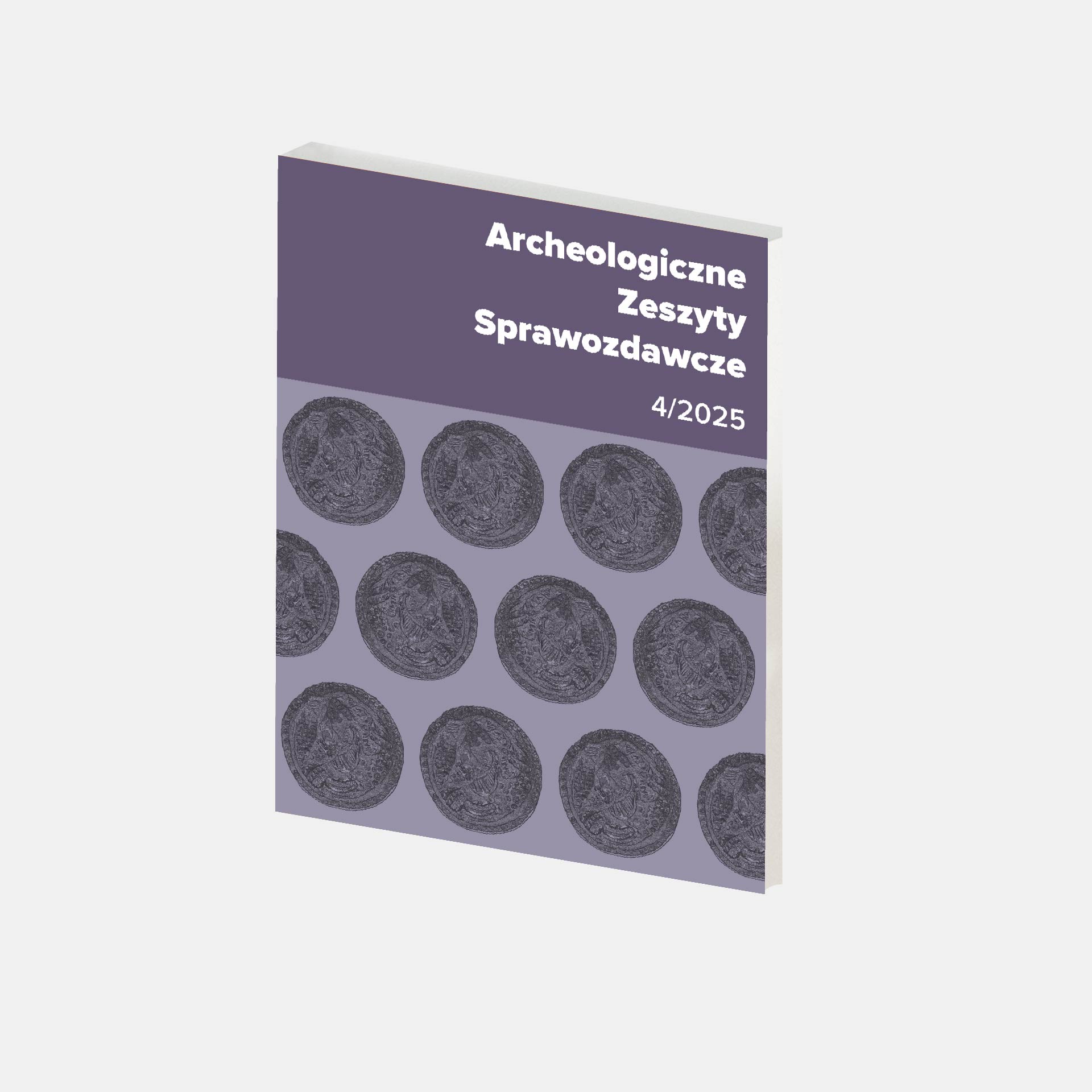
Contents of the Issue
Sylwia Rodak, Ewa Lisowska Osada z młodszych faz wczesnego średniowiecza w Słotwinie, pow. Świdnicki
The paper presents the results of excavation of a settlement from the 11th-12th centuries unearthed in Słotwina near Świdnica in Lower Silesia. There was excavated more than 500 archaeological features from different epochs, some of them can be considered as the remains of early medieval dwellings and other accompanying features. Artefacts are dominated by ceramics decorated with ambient grooves. The bottoms of the vessels have potter’s marks depicting different variations of the cross. The axe from 11th – the half of 12th century is an unique example of medieval weaponry from this region. The site in Słotwina is a single early medieval settlement near Świdnica that has been revealed by excavation.
Jakub Rąpała, Michał Lis Zabytki wczesnośredniowieczne odkryte podczas badań archeologicznych w zachodniej części wzgórza wawelskiego w latach 2023–2024
The article presents the results of archaeological research conducted between 2023 and 2024 on the western slope of Wawel Hill. The text expands existing knowledge regarding the course and structure of early medieval fortifications and provides an identification of stratigraphy dated from the 10th to the 13th century. The research findings reveal the development of wood-and-earth ramparts and evidence of structural repairs. During the excavation work, remains of a settlement phase preceding the construction of the defensive fortifications were uncovered. The published site is characterized by a rich assemblage of white pottery. The study is completed by an analysis of movable finds, supplemented by statistical analysis.
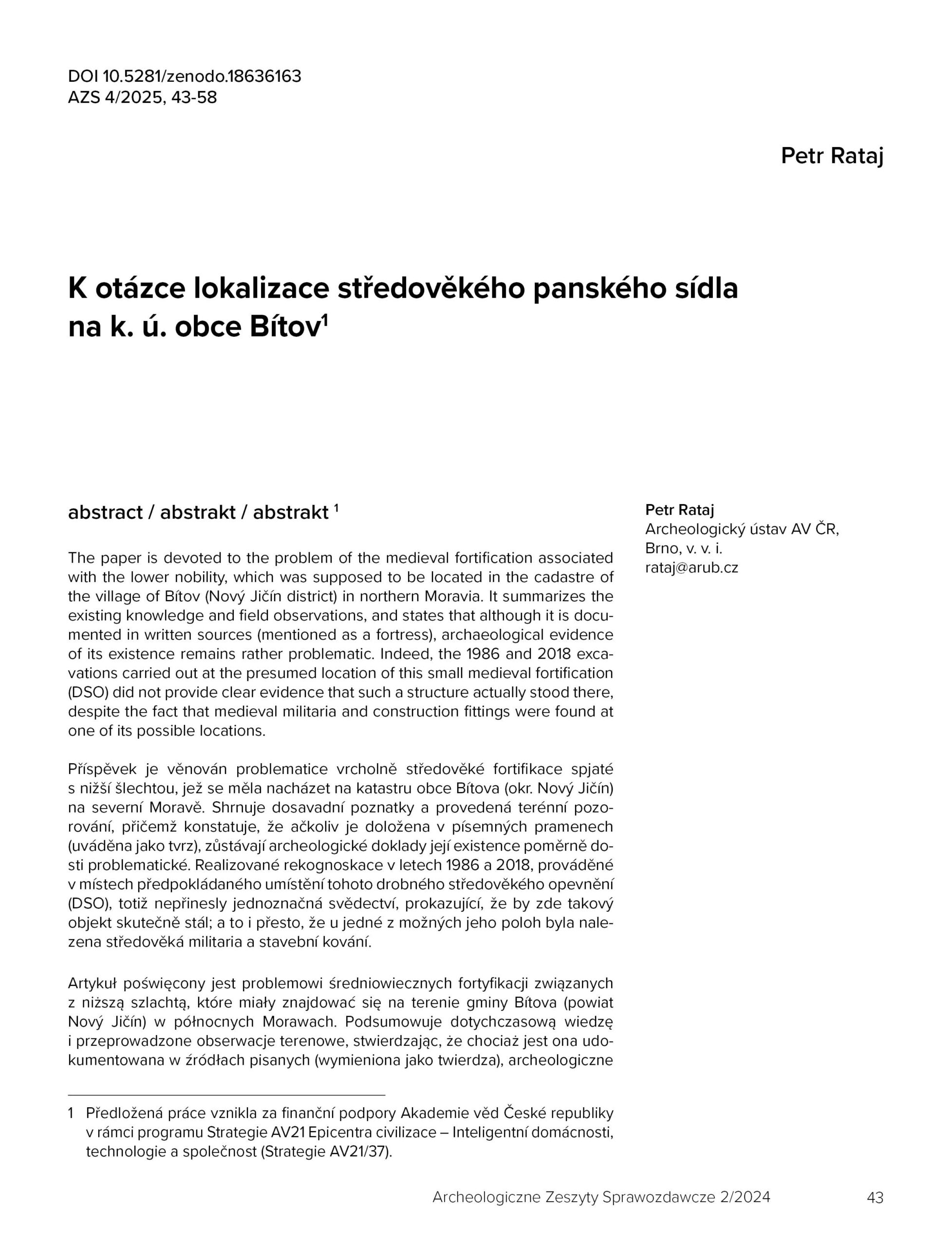
Petr Rataj K otázce lokalizace středověkého panského sídla na k. ú. obce Bítov
The paper is devoted to the problem of the medieval fortification associated with the lower nobility, which was supposed to be located in the cadastre of the village of Bítov (Nový Jičín district) in northern Moravia. It summarizes the existing knowledge and field observations, and states that although it is documented in written sources (mentioned as a fortress), archaeological evidence of its existence remains rather problematic. Indeed, the 1986 and 2018 excavations carried out at the presumed location of this small medieval fortification (DSO) did not provide clear evidence that such a structure actually stood there, despite the fact that medieval militaria and construction fittings were found at one of its possible locations.
Krzysztof Bratko Emaliowana fibula prowincjonalnorzymska z okolic Kazimierzy Wielkiej
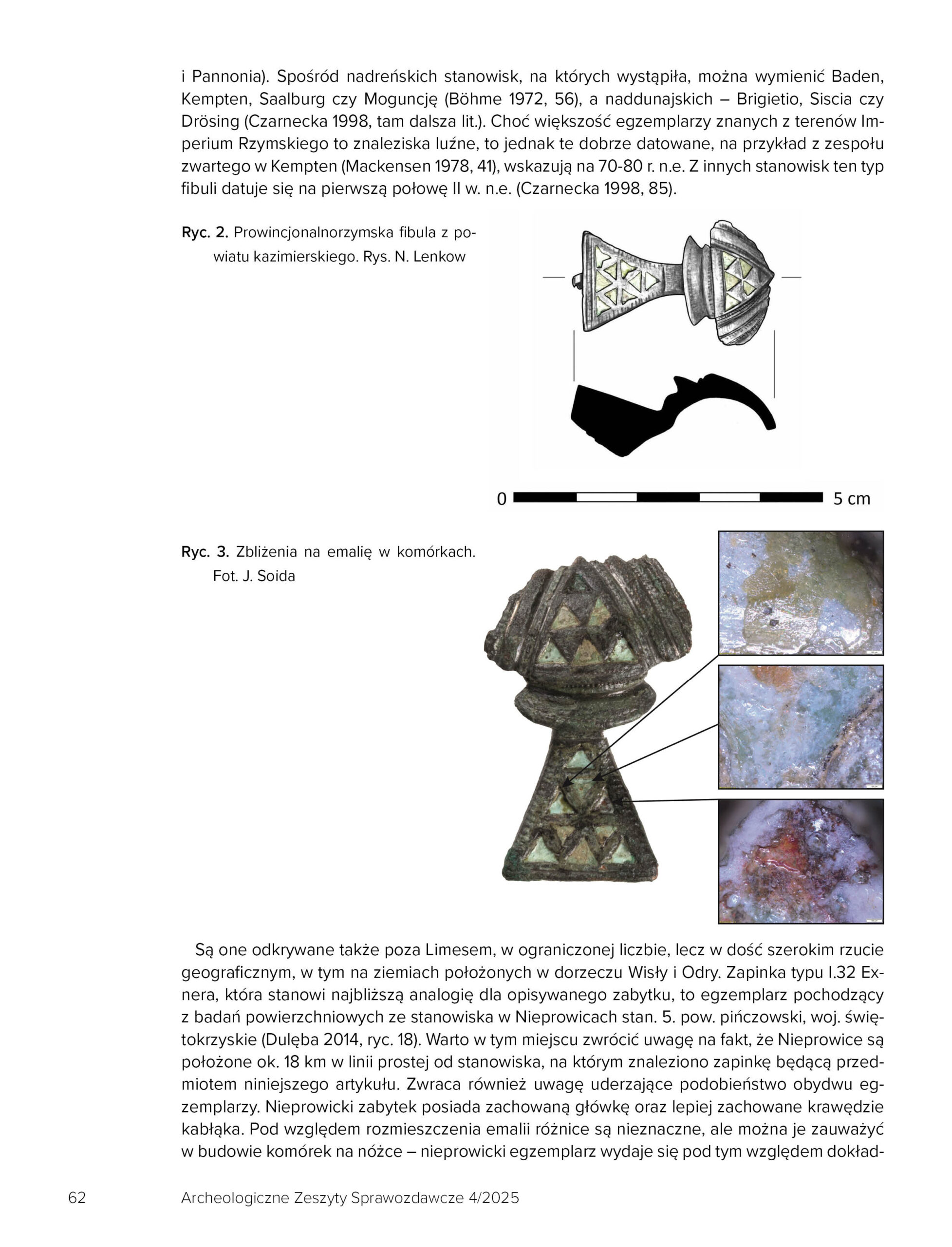
The article discusses a Roman brooch, newly discovered in the vicinity of Kazimierza Wielka, Świętokrzyskie voivodship. The brooch was found during a metal detector survey. One can atribute this brooch to type I.32 according to Exner’s typology of Roman brooches. The distinctive features of this type are two plates decorated with triangular cells filled with enamel. The type was produced in the Danubian and Rhein regions of the Roman Empire during the 1st and the 2nd centuries AD. There are only a few brooches of this type known to have been found in Poland. Those were recorded in child graves. Considering that another brooch of this type was found at a nearby site in Nieprowice, one can see that this region is of a special significance for archaeologists.
Kyrylo Myzgin, Jacek Pikulski A Unique Roman Medallion Imitation from Site 2 in Jakuszowice (Świętokrzyskie Voivodeship, Poland)
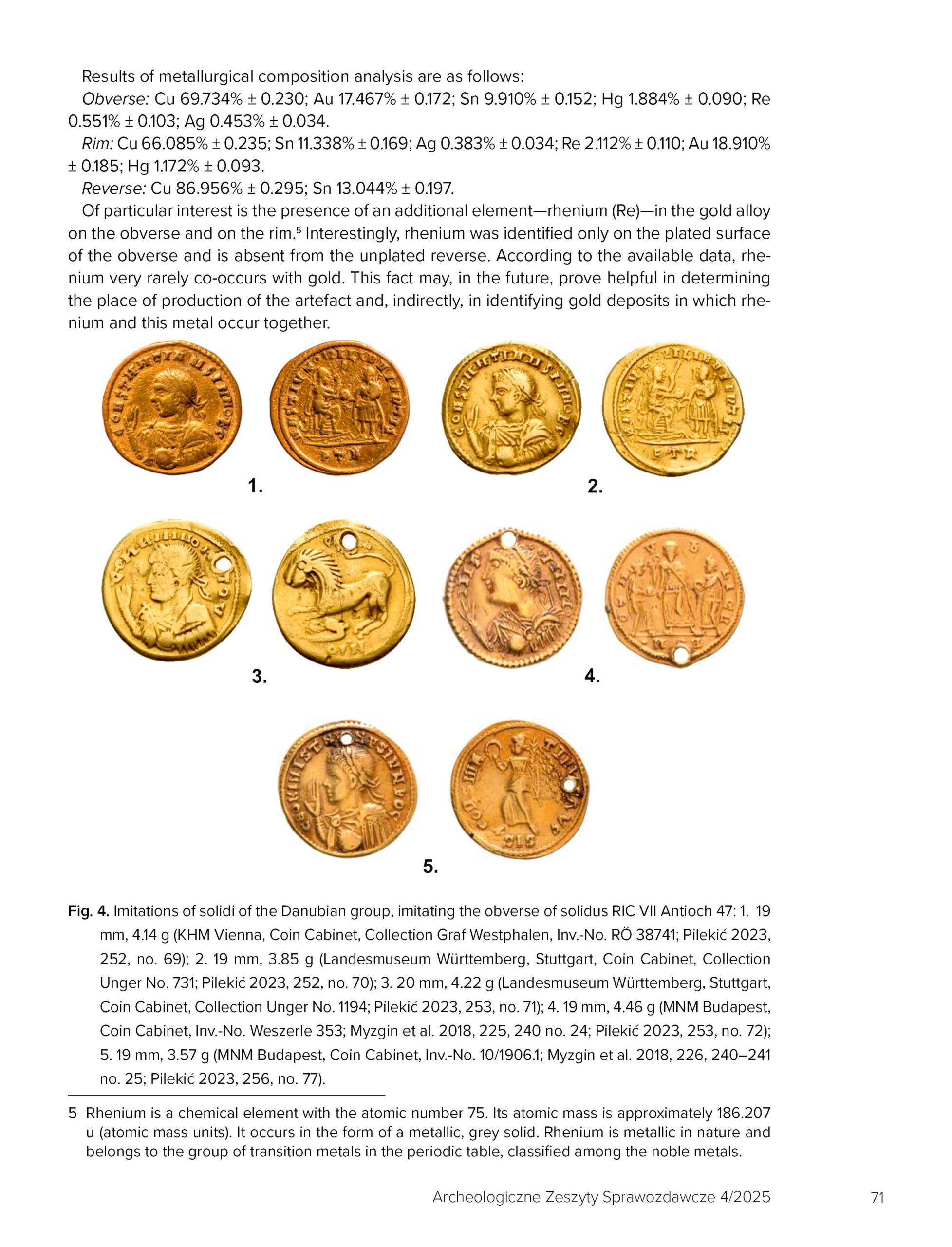
This article presents the results of the most recent archaeological investigations carried out in Jakuszowice (Kazimierza Wielka District, Świętokrzyskie Voivodeship) within the framework of the field project provisionally named the “Terra Incognita” expedition. The fieldwork, aimed at identifying the settlement network in the vicinity of the site, yielded a rich and diverse assemblage of finds from the Roman period and the Migration Period, including a unique artefact: a bronze, gold-plated disc bearing the image of a figure modeled on the portrait of a Roman emperor, most likely Constantine II. Stylistic and technological analysis indicates that this is most probably a barbarian imitation of a Roman uniface medallion, intended to serve as a prestigious symbol of social status. Metallurgical analysis revealed the presence of the element rhenium (Re) in the gold-plated layer, a potentially significant indicator for future identification of the raw material source and the place of production of the artefact. Due to its uniqueness and archaeological context, this discovery sheds new light on the adoption and adaptation of elements of imperial symbolism among the elites of the Barbaricum, emphasizing the important role of the Jakuszowice microregion within the socio-settlement structures of southern Poland during the Iron Age.
Daniel Czernek Małopolskie krążki zdobione współśrodkowymi okręgami. Nowe odkrycia – nowe interpretacje
The article presents the results of recent research on a group of metal discs (so-called “circles within circles”) decorated with a stamped ornament composed of a series of concentric rings. Since the 2024 publication (Czernek, Pikulski, Trojan 2024), the number of known specimens has increased to 122. Morphological and technological analyses allow the identification of both single- and double-sided decorated examples. Some discs show traces of secondary perforations and repairs, suggesting long-term use. In several cases, preserved wire fragments indicate possible attachment to other objects, such as belts, brooches, or harness fittings. Based on the available data, the discs can tentatively be identified as decorative or functional elements, probably parts of horse harnesses or items of dress. The distribution of finds suggests a regional phenomenon concentrated in the central part of historical Lesser Poland. However, the continuing lack of a precise archaeological context prevents the reliable dating of these artefacts.
Bartłomiej Szymon Szmoniewski, Jacek Pikulski, Marek Trojan Metalowe okucie kalety/torebki typu litewskiego z Zagórzyc, st. 3, pow. Kazimierza Wielka, woj.świętokrzyskie
The subject of this report is a cast fitting made of a copper alloy, discovered during archaeological research at site 3 in Zagórzyce, Kazimierza Wielka commune, Świętokrzyskie province. The artifact can be classified as a central fitting of a Lithuanian-type pouch/bag, type V, variant II according to the classification by E. Svetikas (2003), and type A–B according to the typology by J. Sawicki and P. Karpiński (2017). The chronology of analogous finds from the territory of Lithuania is dated from the last quarter of the 16th century to the first half of the 17th century (Svetikas 2003).
Klaudia Bibrowska, Róża Krawczyk, Roland Mruczek Zamek Radosno – czy możliwa jest rekonstrukcja obiektu zachowanego szczątkowo?
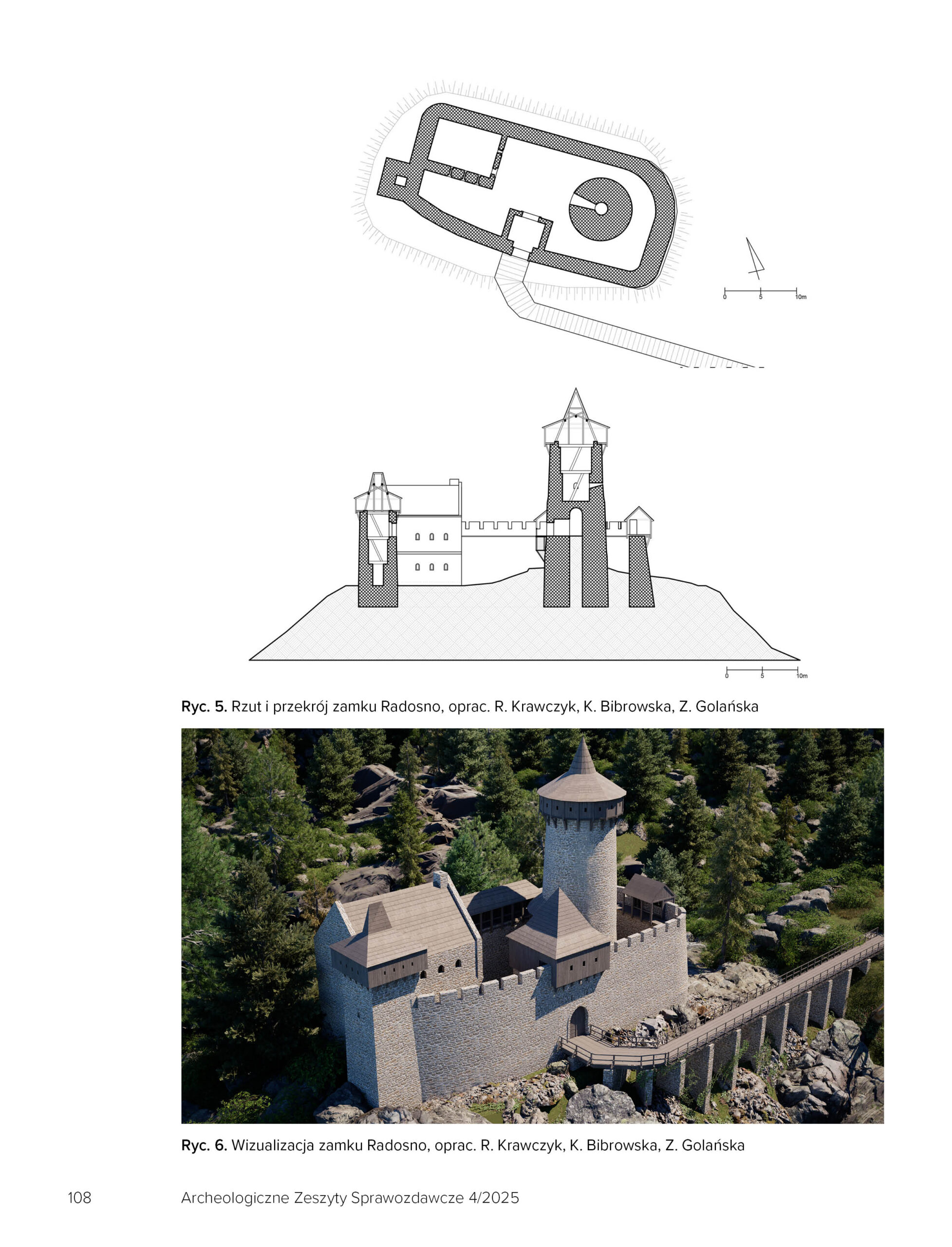
The article concerns research and the possibility of reconstructing the spatial and functional layout of Radosno Castle, located in the Suchy Mountains in the municipality of Mieroszów. The work involved analysing literature, archaeological research reports and iconographic materials. During the reconstruction work, a number of analogies were also collected, which were referred to when recreating the final form of the castle. Key to the reconstruction was research on bergfried towers, which greatly facilitated the identification of the possible form of the structure in question. After the analyses, a model of Radosno Castle was created with perimeter walls on a rectangular plan, with a residential house, a four-sided tower and a gatehouse in the face of the walls, and a tower of last defence (or bergfried) located in the courtyard. As part of the work on Radosno Castle, preliminary research was also conducted on the use of artificial intelligence (AI) algorithms to assist in the reconstruction of partially preserved historical buildings. To this end, various language models were asked to generate an image of Radosno Castle. The results were not always satisfactory, which confirmed the need to build comprehensive databases and to have a wide range of experts supervise the future use of artificial intelligence in the reconstruction of historical buildings.
Julia Fiałkowska, Wiktoria Frątczak, Katarzyna Komorowska Kamienica Rynek 60 we Wrocławiu. Rekonstrukcja przemian elewacji od baroku do XXI wieku na podstawie źródeł historycznych oraz sztucznej inteligencji
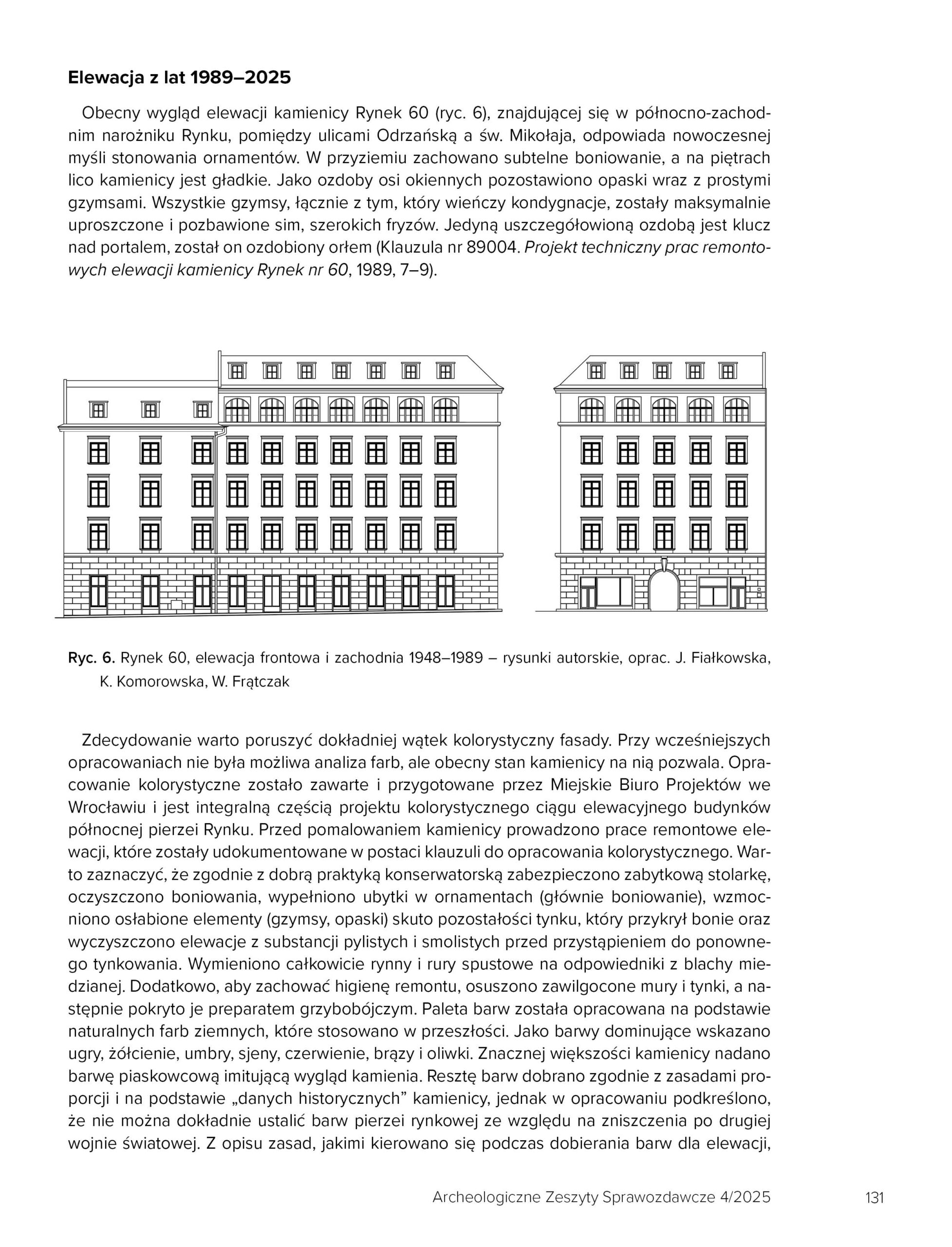
The tenement house located at Rynek 60 in Wrocław represents a unique example, within the local context, of a wide-fronted burgher house developed on a full-curia foundation plot, whose parcellation structure has remained intact from the Middle Ages to the present day. This research paper attempts to reconstruct the transformations of the building’s facade from the late 17th to the 21st century, focusing on identifying the style, analyzing the composition of facade elements, and reconstructing the architectural details used.
The historical reconstruction began with an analysis of archival drawing sources and scholarly literature. These sources proved to be an insufficient database for a reliable study of the facade, particularly regarding details that could not be interpreted. Thus, the question arose: where to quickly obtain an additional source that would enable the verification of details and fit the investigated architectural context. Such a possibility was provided by the use of a publicly available AI model which, based on an analysis of a database of analogous examples, can assist the architect by providing design guidelines during the reconstruction process, while still allowing room for professional critique of the results.
Does the proposed solution have the potential to become a future tool supporting conservation and reconstruction efforts, as well as research into architectural cultural heritage? The aim of this work is not only to present the results of the analysis of the facade changes at Rynek 60, but also to invite reflection on the future use of artificial intelligence in the reconstruction process.
Krzysztof Herner Zintegrowane metody pomiarowe 3D w środowisku wyrobisk górniczych
In the second decade of the 21st century, we rely on computer memory more than ever before, which significantly increases our human capacity to remember and recall information. This digital extension also affects institutions such as museums, where digital archives are created by capturing and storing vast amounts of data. Advancing digitisation brings us solutions that were unattainable just a few years ago. Today, thanks to solutions such as mobile laser scanning, we are able to capture the reality that surrounds us or digitise what is invisible to the naked eye – the underground. Using the example of the digitisation studio at the Coal Mining Museum in Zabrze, the article presents the GEOSLAM method in the documentation of mining excavations.
Mining tunnels and galleries constitute the primary spaces for extraction operations, where most of the underground technical infrastructure is installed. The operation and maintenance of this equipment are among the main tasks of miners, while simultaneously requiring constant monitoring of the technical condition of the workings.
The digitization of tangible heritage focuses on documenting and interpreting human experiences, history, and narratives preserved, among others, in the historical urban fabric or its remnants. Building the significance of a given heritage in collective memory is inseparably linked to the process of its creation and its ability to survive subsequent socio-cultural transformations. Currently, the mining sector in Upper Silesia is at a particularly critical juncture, having reached a turning point as a result of European Union climate policy. Although the fate of most mining plants has already been sealed, the memory of them should be preserved through reliable and systematic documentation.”
Sebastian Tyszczuk, Marcin Lewandowski Wybrane przykłady wykorzystania proporcji geometrycznych przy lokalizacji położenia otworów oraz dobierania średnicy wiertła jako przesłanka do typologii wytwórczej kamiennych toporów okresu neolitu – analiza metryczna na bazie pomiarów 3D
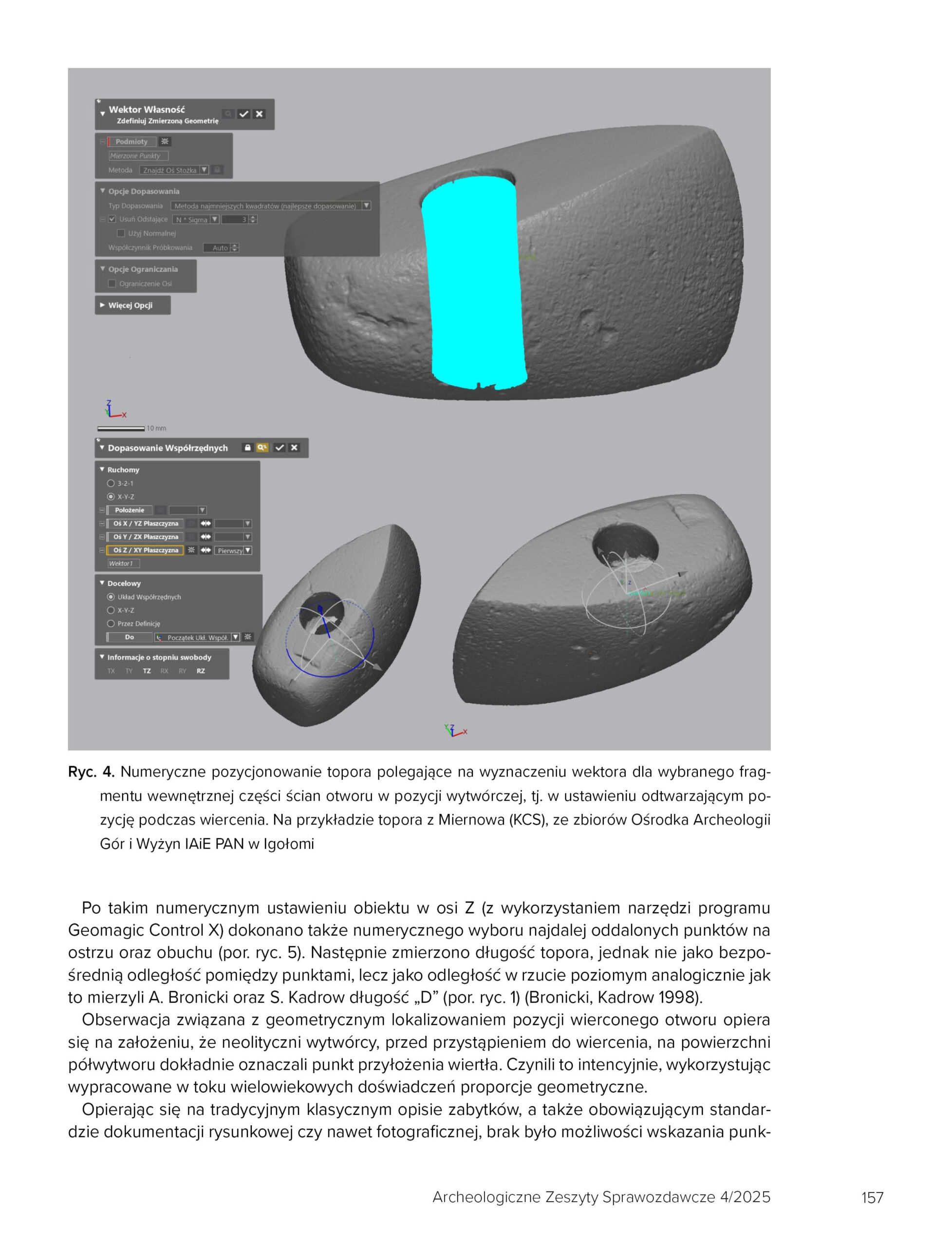
The location of the shaft hole in Neolithic stone axes has traditionally been treated primarily as a descriptive feature and only rarely as an independent typological criterion. Although earlier classifications (including those by Machnik, Libera and Sobieraj) acknowledged the variability in the placement and drilling methods of the holes, the absence of precise measurement tools prevented a detailed analysis of this attribute. Quantitative approaches to axe proportions, such as those proposed by Bronicki and Kadrow, did not include an in‑depth assessment of hole position. Only the introduction of 3D scanning technologies has enabled accurate determination of geometric parameters, including the placement of the shaft hole as a potentially significant classificatory feature. The aim of this article is to present the results of such analyses and to propose a new typology of Neolithic axes based on the method of locating the hole on the preform—an approach grounded in manufacturing practices and complementary to existing stylistic and morphological classifications.
Ewa Lisowska Kronika 2025: Szczątki rakiety Falcon 9 spadły przy grodzisku wczesnośredniowiecznym w Sędzinku
In February 2025, fragments of a Falcon 9 rocket, following an unsuccessful deorbiting maneuver, fell onto the area of an early medieval stronghold in Sędzinko (Greater Poland). This unprecedented incident revealed the absence of procedures for protecting archaeological heritage from damage caused by space objects, whose number in Earth’s orbit continues to grow. The article discusses the course of the event, its legal context, and the need to develop regulations safeguarding archaeological sites against emerging risks associated with intensified space activity.
Natalia Sawicka Biblioteka to nie tylko książki
The article presents the activities of the Library of the Institute of Archaeology at the University of Wrocław in 2025, highlighting its role as a space for social engagement and academic community building. The initiatives described—such as the Valentine’s postal project, participation in the university-wide “Obiegówka” game, the “Library Walks” series, workshops on creating archaeology-themed Christmas ornaments, and the installation of a large recycled-paper chain—illustrate grassroots efforts carried out without external funding. The text emphasizes the library’s function as a place that fosters collaboration among students, staff, and alumni, while promoting archaeology through educational and integrative events.
Only logged in customers who have purchased this product may leave a review.
Subscribe to our newsletter and don’t miss information about new publications and information about the life of the publishing house.




Reviews
There are no reviews yet.